
Common Signs of Abuse and What to Do About It
Domestic abuse used to be a somewhat hidden topic. It may have seemed too shameful to speak about, especially because of the strong possibility that disclosure would be met with skepticism. Although it’s become more acceptable to talk about abuse today, victims are still often met with disbelief or blame. For this reason, among others, they are often afraid to talk about their experience.
In this article, we’ll discuss the most statistically prevalent form of abuse, which is committed by a male perpetrator on a female victim. (It is possible for any gender to commit abuse, which means men can be victims as well.)
Here are some of the most frequent questions I am asked as a domestic abuse counselor:
- If there’s no physical violence, is it really abuse?
- If he’s never touched me but is threatening and controlling, is this abuse?
- Is it possible to fix the relationship?
 I want this article to be a place to define domestic abuse. I’ll also list some of the most common signs for outsiders to be aware of, and for victims to be able to confirm that what they are experiencing is indeed abuse. I’ll also outline what steps a victim can take upon finding themselves in an abusive situation. Huntington Beach Christian Counseling provides compassionate support and guidance for those facing such challenges.
The Definition of Domestic Abuse
Abuse is rooted in a sense of entitlement and a desire for control. The attempt to control can involve many different behaviors, including threats, fear-mongering, physical violence, or other attempts to limit the victim’s independence.
Domestic abuse does not discriminate. It can happen to anyone. Its cyclical nature traps victims into believing that it’s eventually going to change, but then it never does. It crosses socio-economic, racial, and religious barriers, and it can happen to victims of any age.
Because of how insidious domestic abuse is, it’s often difficult for victims to fully acknowledge what’s happening to them. Domestic abuse tends to escalate over time, making the victim’s situation increasingly dangerous.
Acknowledging the abuse is the first step. Recognizing what’s happening to you includes the realization that you are worth far more than this and don’t deserve to be treated in such a way (although the abuser will try to blame you).
Meeting with a professional can be the next step, but make sure that you are doing so safely to avoid retaliatory actions from your abuser. When a victim takes even a small step towards independence, abuse can escalate quickly.
Common Signs of Abuse: The Power and Control Wheel
The “Power and Control Wheel” is a resource used by the National Domestic Violence Hotline. It divides abuse into eight categories, which you can see in the following image. Here you’ll see that abuse includes but is not limited to physical actions.
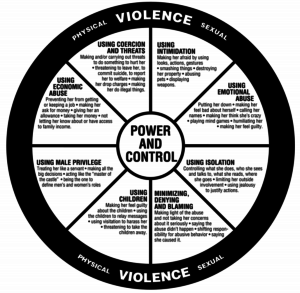
Coercion and threats: This can include self-harm, threats of suicide, or threats to hurt you or someone you love. Possible threats include violent ones, but other forms of harm are included as well.
An abuser may threaten to get you in trouble in some way or take something you value. These threats are made in order to intimidate you so you’ll submit to their demands or allow them to further abuse you. Threats of self-harm may also be used, in order to guilt you into giving in to the abuser’s demands.
 Domestic abuse does not always happen how you might think. It can start small and build up from there. Often, abusers choose kind-hearted, empathetic victims whose very strengths are used against them. The victims are then manipulated into a life of submission to a controlling, abusive partner.
Intimidation: This form of abuse is related to coercion and threats. Intimidation describes the instilling of fear to force the victim into compliance. If the victim does not comply, she knows there will be consequences.
Emotional abuse: This type of abuse can be easy to hide or deny. Since it doesn’t leave physical scars, the abuser often claims the abuse didn’t happen or that the victim is exaggerating, being overly sensitive, etc.
Emotional abuse is a pattern of mind games, put-downs, insults that may or may not be disguised as jokes, minimizing, denying, blame-shifting, gaslighting, using male privilege, and more. The effect of this over time is that the victim’s confidence and self-worth drastically deteriorate. The victim then finds herself constantly seeking the intermittent reinforcement (periods of affection, approval, compliments, etc.) that the abuser periodically doles out.
This type of abuse can seem subtle, but it can eventually overtake the entire relationship and become normalized. When you’re coming to terms with emotional abuse, you need to know that it is not okay for your partner to degrade you, bully you, or verbally abuse you.
Emotionally abusive partners will seek (whether consciously or subconsciously) to condition their victim to accept this unacceptable and cruel behavior, but it is not normal or acceptable, and you do not deserve it.
Isolation is another form of control used by abusive partners. Little by little, the abuser removes your independence. You lose control over your time, spend less time with your friends and family, and become completely absorbed in the relationship. Not only does this isolation enable more abuse to take place, but it also removes both witnesses and influencers who could help break the cycle.
Over time, the abuse escalates as the victim becomes more isolated, and then she has no one to talk to. This benefits the abuser because the more isolated the victim is, the less likely someone will convince her that he’s abusive and she needs to leave.
Many domestic abusers will minimize and deny that the abuse is even happening. The abuser can also blame their significant other for the abuse. This can be very confusing for the victim. I have heard clients say things like, “Am I going crazy? Is this really not happening?” This is all part of the abuser’s control tactics, by making you feel “crazy” and/or confused, and he can keep the abuse going.
Minimizing and denying: This is an integral part of abuse. Very few abusers are violent, angry, or mean 24/7. They intersperse their abuse with occasional good treatment (although this can become more and more rare as the abuse escalates).
 This keeps the victim confused and off-balance. She might think that the latest abusive incident is the last one. She might think it’s her fault, which he would like to convince her of, especially if she responds emotionally or angrily to his treatment of her.
Often the abuser will convince the victim that his treatment of her is not that big of a deal, that she’s just too sensitive, that all relationships are like this, or that it didn’t happen at all. (This is especially powerful if he is not physically violent but sticks to emotional abuse. How can she prove it, even to herself?)
Abusers also gaslight their victims by claiming to forget an abusive incident or twisting it to make it seem like it happened differently than it did.
Using children: Abusive partners often use children as pawns in their quest to control their victim. They take advantage of a mother’s fierce maternal instincts and manipulate that love to intimidate, threaten, manipulate, and/or demean her.
One of the most frequent and potent examples of this is when an abuser threatens to take the kids and prevent the victim from seeing them. He does this so she will agree to his terms. It can be terrifying to encounter this and know what to do next to both escape the abuse and not lose the children.
Male privilege: This type of abuse is when a man uses his gender as a basis for power and control. He bases his demands on the fact that he is the man of the house, or on his twisted view of traditional gender roles. Many healthy marriages are based on traditional gender roles, but it is not healthy when a man uses “gender roles” to control his partner.
He does this to create an imbalance of power so he can make unilateral decisions without taking her thoughts or wishes into account. This leads to a feeling of helplessness on the part of the victim. She might feel as if she has no say in anything about her life or decisions for the family.
Economic abuse: This is another form of subtle abuse that is very difficult to identify and address. It involves the woman being financially dependent and the man using this to control her and benefit himself. This can take many forms, and it can happen whether or not she is working herself.
What Should I Do Now?
If you have read this and started to realize that you are in an abusive relationship, or maybe that someone you know is, it’s important to know what to do next.
 Assessing the safety and risks is the important factor. Once a woman begins to make efforts to change the relationship or to leave the situation, the risk of violence increases exponentially. Making a safety plan is paramount if you believe there is even the slightest risk of violence.
Listen to your intuition; it’s a powerful ally. Physical abuse can begin suddenly even if only non-physical abuse was happening before. The National Domestic Hotline (1-800-799-7233) can be a good place to start assessing your safety and deciding what to do next.
Seek Counseling
A counselor can be an invaluable resource if you feel that you are experiencing domestic abuse. The isolation of abuse can make freedom seem almost impossible to attain. Doing it alone is overwhelming, and it’s easy for the abuser to maintain control.
The support and professional guidance you’ll receive from a Christian counselor can help alleviate the anxiety of this process. We will walk with you as you begin your journey to safety, freedom, and healing.
Escaping a domestic abuse situation is not simple. A counselor can help you to carry out the next indicated actions, as well as providing practical help making a safety plan, finding lawyers, medical professionals, understanding the law, and more.
The emotions and possibly trauma involved in domestic abuse will require a committed and extended recovery process. Feelings of low self-worth are common and normal after abuse. Counseling can help you process what you’ve been through and find a healthy place of recovery, hope, and personal growth. Christian Counselors at Huntington Beach Christian Counseling can provide the support you need on this journey.
The Lord provides comfort for His children. We want to help you seek a relationship with Him so that you can lean on Him each day of this difficult journey. He loves you and does not desire for you to be abused and mistreated.
“I sought the Lord, and He answered me and delivered me from all my fears.” (Psalm 34:4) As Christian counselors, we desire to be instruments of His freedom and healing. You do not have to go through this alone.
“Alone,” courtesy of Tiko Giorgadze, unsplash.com, CC0 License; “Hurt”, Courtesy of Dmitry Ratushny, Unsplash.com; CC0 License; “Victim”, Courtesy of Zach Guinta, Unsplash.com, CC0 License; “Reflection”, Courtesy of AKi Kikuti, Flickr.com, CC 2.0 License
 Therapists, however, know that this is incorrect. As an integrated unit, the dynamics within the family affect each member, with some more adversely impacted than others. Research has also shown that family members may be the enablers of the “unwanted behavior” of their struggling loved one.
 A common result is seen in families when one of the children misbehaves – one parent punishes the child, while the other “rescues” him or her. The parents then come together to discuss the issue. This is called triangulation, where a third party (the child) acts as the “connection” between the opposing two (the parents).
 When treating a family, the Christian family counselor usually starts with the marriage relationship and its effects on everybody else. The spouses are encouraged to settle their differences and rekindle the love that was once there so that the family unit can become strong once more. They are then taught how to deal with the negative behavior and how to come up with a parental approach for future issues.
 Opposite to ridged boundaries are enmeshed ones. In this family type, parents are overprotective and involved, hovering around their kids to ensure that they are always okay. These are the parents who end up completing their children’s homework, arguing with the teacher or coach when their child is not given a chance, ensuring that their kids always have an advantage over others.
 But it’s also possible that you may have some mixed feelings. Maybe you’re concerned about some things in your relationship and wonder how they’ll affect your future. It’s okay to be nervous or have reservations about making such a huge commitment.
 It’s also good, although a little scarier, to discuss the insecurities you have related to who your partner is. Are there any red flags (even small ones)? These are the insecurities. What are the issues you desire to discuss but maybe feel uncomfortable bringing up?
 Will adoption or travel be a part of your future? What are your educational and vocational aspirations? What are your partner’s? Do you want to stay in your current geographical area indefinitely?
 These questions aren’t meant to discover a right or wrong answer, but simply to foster open communication in your relationship. The goal is to have an agreed-upon timeframe that will not make either partner feel overly rushed but will also not draw out the engagement far beyond what is desired.
 People often approach productivity on either end of a spectrum. On one hand, you might be more spontaneous and neglect planning. On the other hand, you might be controlling and too focused on an outcome.
  Planning is the easy part compared to carrying out the plan. The reason we make plans, or set objectives, is so that our efforts lead to the best possible outcome. This is why we recommend starting with one main objective in your professional development plan.
 Depending on your main objective, your alternatives might still be at a high level (pursuing a new degree, for example). If this is the case, you’ll need to break them down into smaller steps you can take.
 People experiencing job burnout describe it in different ways. Some feel like they are in a panic or even “lost” as they are no longer sure about what it is they are doing.
 3. Understand that being burned out is not unusual as many people will experience something like this at some point in their life (to varying degrees). And know that God sees your need and is just waiting for you to ask for His help.
 Big achievers do things with intention. These intentions are manageable goals that are part of their overall plan which is usually seen through, either by themselves or with the right help. Without them, one’s dreams may be impossible to achieve.
 “Come to me, all you who are weary and burdened, and I will give you rest. Take my yoke upon you and learn from me, for I am gentle and humble in heart, and you will find rest for your souls. For my yoke is easy and my burden is light.” –
  Anxiety can prevent us from taking part in social activities. It can cause us to have problems at work or keep us from going to gatherings. When we are missing out, it is high time to take a close look at our anxiety and the social phobia it is causing in order to better understand it and to better enable us to get help.
  Try to get a grip on it through taking deep, controlled breaths. Breathe in through your nose and then out slowly through your mouth, counting to three. Once you have completed the deep breathing exercise, attempt to figure out what the trigger is.
 Controlling our focus is the key to stopping the circus. It takes some practice but it can be done. When you think of positive things about yourself, you will find that your anxiousness subsides. A good bit of the worry we have is based on things that are not true. You may feel God is going to punish you for something or that you are going to get a disease. Think of fears you had in the past that never came to pass. That is very helpful in recognizing the unwarranted fears.
 If all environmental factors have been ruled out, it could very well boil down to a psychodynamic contributor, like having an overly critical father or mother who continually made him feel belittled. While this issue is one that can take some time to really work through, there are short-term solutions that can temporarily help to boost his self-confidence.
 We’ve all heard of depression, but how much do we really understand about it? It’s often misunderstood in terms of its clinical diagnosis and greatly overused in pop culture.
  If you’re noticing that you’re very short-tempered or yelling at your spouse or kids a lot, or otherwise lashing out. Instead of working through your feelings, and identifying their root cause you may project them onto others, blaming those around you for the feelings you have about yourself.
 Another common symptom associated with clinal depression is being extremely restless at night and constantly tired during the day when awake, with little to no motivation to get out of bed to start daily activities. Going to work, or getting the kids on the bus in the morning becomes overwhelming. Even trips to the grocery store may begin to seem like they are simply too much to handle.
 It is common for people who are experiencing depression to experience a decreased or complete loss of interest in life. Things that once provided a sense of accomplishment or fulfillment no longer provide any satisfaction. Spending time with friends or family becomes more of a chore as isolation and solitude increase.
 Even the normal things you did are not the same. The insatiable appetite you once had has dwindled to barely being hungry at all.
 Girls are generally the first to undergo visible physical changes. The earlier they do so, the more difficult the adjustments may be. They take note that they are “different” which can make the changes even rougher. Soon enough, boys find themselves in the midst of puberty, too, and begin comparing themselves and their changes to that of their peers. Late bloomers may have the hardest time of all whether male or female.
 Not only can social media platforms open up a sea of opportunities to stage bully battlegrounds, they can also promote the temptation to compare. There’s the popular girl who just got asked to prom, the football jock posing in a photo with his new trophy and your friend showing off the new puppy she’d rather spend time with than you. It’s up close, personal and always in your face.
 Within the state of Washington, even thirteen-year-olds have the right to complete privacy in their counseling sessions. While it may seem a bit strange to parents, it certainly is comforting to the teenagers.
 The results of other studies confirm that adolescent self-harm is an issue that is all too prevalent and needs to be taken seriously. The psychology community refers to self-harm as Non-Suicidal Self-Injury (NSSI). The definition of NSSI is:
 If you haven’t struggled with self-harm, you might find it too hard to grasp why someone would hurt themselves. It’s vital to form an understanding of the reasons behind self-injury. This allows us to offer true empathy and support.
 According to research, self-injury is a significant risk factor for suicide attempts. Researchers Klonsky, May, and Glenn (2013) found an association between the two. Moreover, they discovered that self-injury was the second leading risk factor for suicide attempts, suicidal thoughts being the first.
 As we have seen, self-injury can become a pattern that is very hard to stop. The individual may use it as a coping mechanism and a consistent way to ease their emotional pain. When they attempt to stop the behavior, they often experience intense urges to revert to it.
 This disorder was labeled codependency. Discovering and defining codependency has led to the creation of treatment programs that work alongside addiction treatment. Professionals assess and treat family dynamics as well as the person struggling with addiction. Mental Health America defines codependency this way:
 “While the teachings of the codependency movement remain immensely helpful in dealing with family members who suffer from substance abuse (as was the initial intention), they can be misleading and even damaging when applied indiscriminately to all relationships.”
 Attached proposes a more balanced approach than the common mental health emphasis on differentiation and emotional independence. Instead, the authors say we should acknowledge that we have an inherent need for attachment and dependence on our partners, and when this need is met, we will feel secure.
 They devote several chapters to explaining the nuances of the different styles and how you can identify which one describes you and which describes your partner. They also give examples of how different types of attachment look in real life, along with solutions for improving your relationship and resolving conflict.